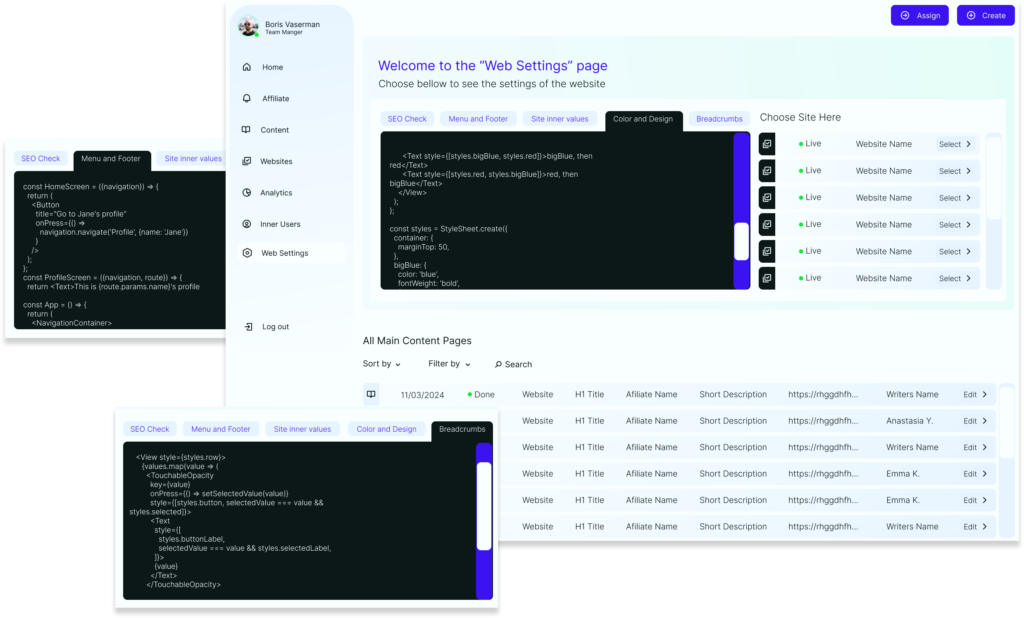
Psefas CMS

unifying fragmented legacy systems
into a high-velocity content engine.

Role Researcher, UX UI, Product Designer

Timeline 2025

The Challenge: Fragmented Infrastructure

The project, named Psefas (Mosaic), was born from mechanical necessity. 
A content team of managers and writers was struggling to maintain over 
30 legacy affiliate websites across three different, “hot-fixed” versions of Drupal.
 

The Core Issues:

  • Operational Chaos: Writers kept dozens of browser tabs open, leading to high context-switching and cross-site errors.
  •  Communication Gaps: Managers often declined articles without feedback; writers resorted to leaving “hidden notes” inside drafts to communicate.
  • Technical Debt: Inconsistent legacy systems were slow, insecure, and damaging global SEO rankings.

User Research & Insights

I conducted 1-on-1 interviews and shadow sessions to define the core needs of our two primary archetypes. 
By understanding their daily friction, I could design a tool that they would actually want to use.
  • The Manager (Anny): Needed to move away from “random checkups” to a 10,000-foot view of team goals and daily affiliate click reports.

  • The Senior Writer (Sarah): Needed “Zen Mode.” Her goal was to focus on content quality without the inconsistent backend.

The Solution: A Unified Headless Command Center

I designed a custom Headless CMS that decoupled the management interface from the diverse frontend displays. 
This allowed us to build a high-performance environment tailored specifically to the team’s rhythm.
 

Key UX Wins:

  •  The “Zero-Noise” Filter: I implemented “Saveable Mega-Filters.” users can now log in and see only her assigned sites in her specific niche.
  • The Feedback Loop: To solve the communication breakdown, I built a mandatory “Reason for Revision” gate.

  • Automated Guardrails: We added a link-matching feature that validates affiliate URLs against the specific niche of the site.

Prototype

The Production Pipeline

We transformed a messy, multi-platform headache into a transparent, three-step linear process.
  • Drafting: Tasks are auto-sorted by deadline, removing the “What do I do first?” anxiety.

  • Review: Integrated chat ensures all revisions stay within the tool, not in external emails or sticky notes.

  • Approval: One-click deployment pushes the content directly to the headless frontend.

Real-World Impact: The Results

The transition to Psefas delivered immediate, measurable ROI.

  • Velocity Increase: Individual production jumped from 3 to 5 articles per day—a 66% boost in output.

  •  Management Efficiency: Anny’s daily check-up time was slashed from hours of manual searching to a 10-minute snapshot review.

  •  SEO & Security: Moving to a headless backend improved Page Speed scores by 10–20 points and reduced the security attack surface of the entire network.

Final Reflection: Pragmatic Design

During the prototyping phase, we developed a mobile view for managers. However, after monitoring the Proof of Concept (POC), we found a lack of actual use. I made the executive decision to remove the mobile view to focus all resources on perfecting the desktop “Workhorse” experience.

Psefas proved that by piecing together fragmented workflows into one cohesive “Mosaic,” you don’t just fix a website—you fix a business.

CRM psefas image 1
CRM psefas image 2
CRM psefas image 3

Lets Talk..

E-mail: curhxv87@gmail.com

Social Networks